
How to Start a Company in Jamaica: A Step-by-Step Guide
Learn how to start and register a company in Jamaica, from COJ incorporation and TRN registration to GCT, payroll, accounting and ongoing compliance.
Last reviewed: October 2026
Starting a company in Jamaica involves more than registering a name.
You have to decide on the right legal structure, establish who will own and manage the company, complete the required Companies Office of Jamaica filings, deal with tax and statutory registrations, determine whether additional licences are required and put the right accounting and compliance systems in place.
The good news is that much of Jamaica’s business registration process has been streamlined, and several registrations are now handled through the Companies Office of Jamaica (COJ).
This guide explains the process step by step.
Important: Government fees, tax thresholds, filing procedures, forms and online systems can change. This guide is designed to remain useful over time, but whenever a specific fee, threshold or deadline is mentioned, you should confirm the current requirement with the relevant government agency before acting.
Company Registration in Jamaica: What Are You Actually Creating?
Before starting the registration process, it is important to understand the difference between registering a company and registering a business name.
They are not the same thing.
A company incorporated under Jamaica’s Companies Act is a separate legal entity from its owners. The company can own assets, enter contracts, borrow money, employ people and sue or be sued in its own name.
A registered business name used by a sole trader or partnership does not normally create that same legal separation between the business and its owner.
That distinction becomes increasingly important as a business grows.
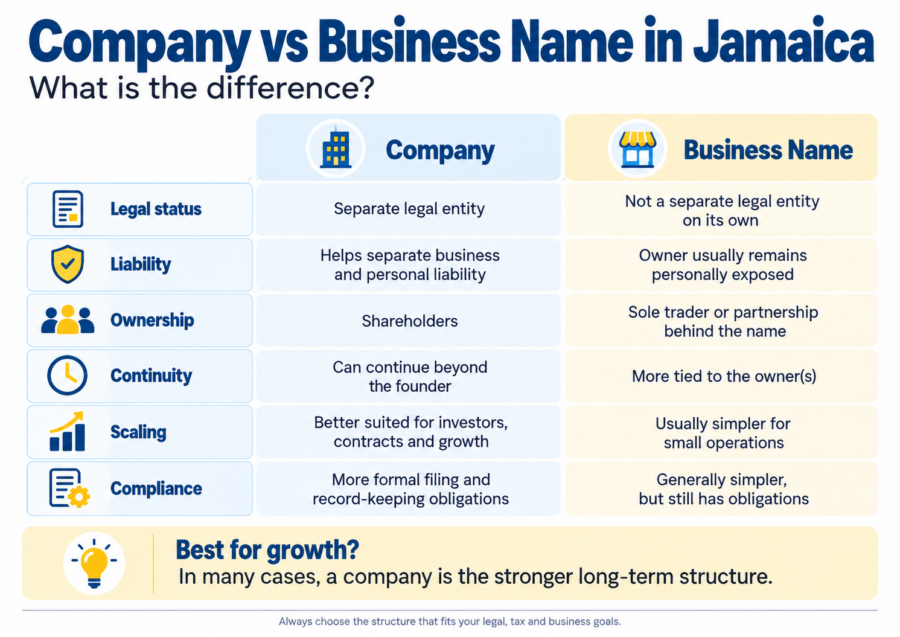
If you intend to bring in investors, sign significant contracts, borrow money, build an organisation that can continue independently of you, or separate business activities from your personal affairs, incorporation may be more appropriate.
COJ itself highlights the distinction between companies registered under the Companies Act and businesses registered under the Registration of Business Names Act.
This guide focuses primarily on forming a Jamaican company, particularly a private company limited by shares, which is a common structure for commercial businesses.
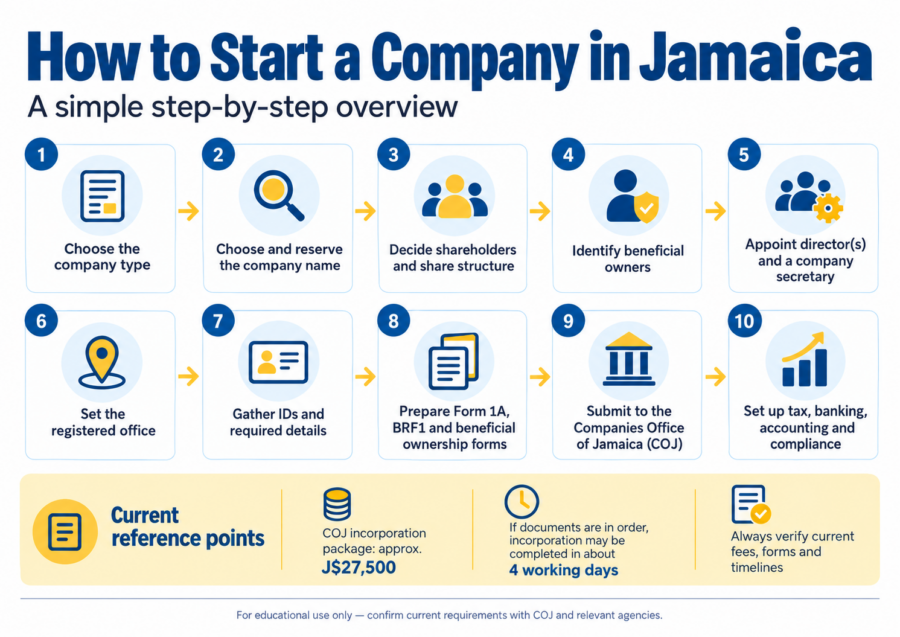
How to Start a Company in Jamaica Step by Step
1. Decide What Type of Company You Need
For most entrepreneurs intending to operate a profit-making business, the usual structure is a company limited by shares.
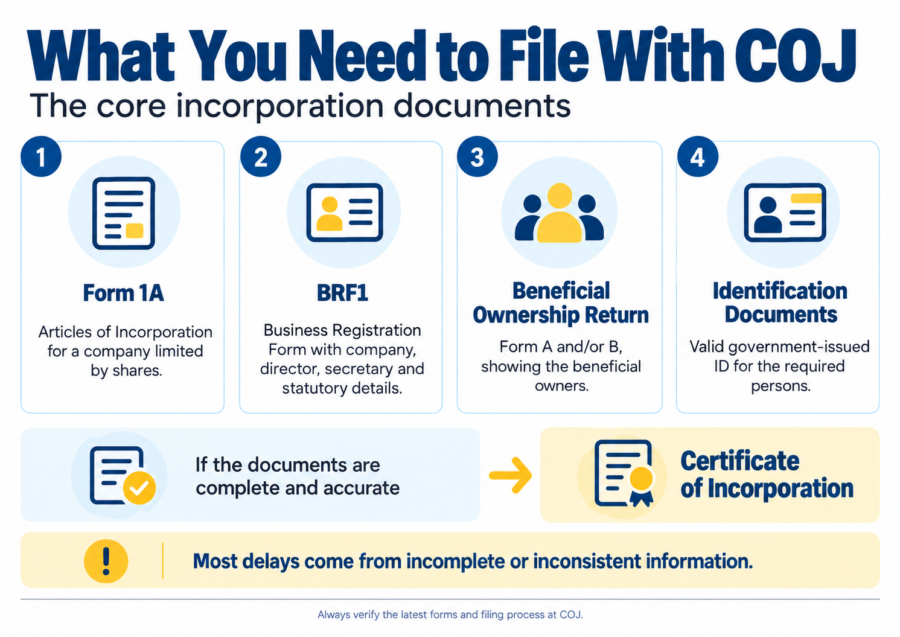
The Companies Office currently uses Form 1A – Articles of Incorporation: Company Limited by Shares for this type of company.
Other structures exist.
For example, Form 1B is used for a company limited by guarantee without a share capital and is commonly associated with non-profit entities. There are also structures for companies limited by guarantee with share capital and unlimited companies.
Choosing the structure should not simply be treated as a paperwork decision. Consider:
the purpose of the organisation, who will own it, whether investors may join later, how profits will be distributed, how much commercial risk the business will carry and whether the organisation intends to seek charitable status.
Being incorporated as a non-profit company, for example, should not automatically be treated as the same thing as receiving approval for every tax or charitable exemption that may be available under Jamaican law.
For a conventional commercial operation, however, a private company limited by shares will often be the starting point.
2. Choose Your Company Name
Your proposed name needs to be acceptable to the Companies Office of Jamaica.
A name may be rejected if it is too similar to an existing registered name or if its use would be misleading or otherwise prohibited.
Some words can also attract additional scrutiny. COJ guidance notes that names associated with areas such as engineering, pharmacy and medicine may require professional justification or certification. Names suggesting connections with royalty or political organisations may also need to be justified.
For a company limited by shares or guarantee, the company’s name generally includes “Limited” as the final word.
Should you reserve the company name first?
Jamaica allows a proposed company name to be reserved before incorporation.
A reservation can currently protect an approved name for up to 90 days. This can be useful if you are not ready to incorporate immediately but want greater certainty around the name before entering agreements, designing branding or making other commitments.
Name reservation fees and procedures can change, so check COJ’s current fee schedule rather than relying on an old article or social-media post.
3. Decide Who Will Own the Company
Do not wait until you are filling out the incorporation forms to decide who owns what.
You should establish:
who the shareholders will be, how many shares will initially be issued, how ownership will be divided and whether different classes of shares are actually necessary.
For many small privately owned businesses, a relatively straightforward ordinary-share structure may be sufficient.
For more complex companies, particularly those involving several investors, family members, outside capital or plans for future investment, the share structure deserves much more thought.
The Articles of Incorporation require information concerning the company’s share structure, including the maximum number of shares the company is authorised to issue and, where applicable, different classes of shares.
Do not confuse the number of shares with the value of the company.
Owning 500 out of 1,000 issued shares may represent 50% ownership whether the company is worth J$100,000 or J$100 million.
This is one area where getting professional advice before incorporation can prevent disputes later.
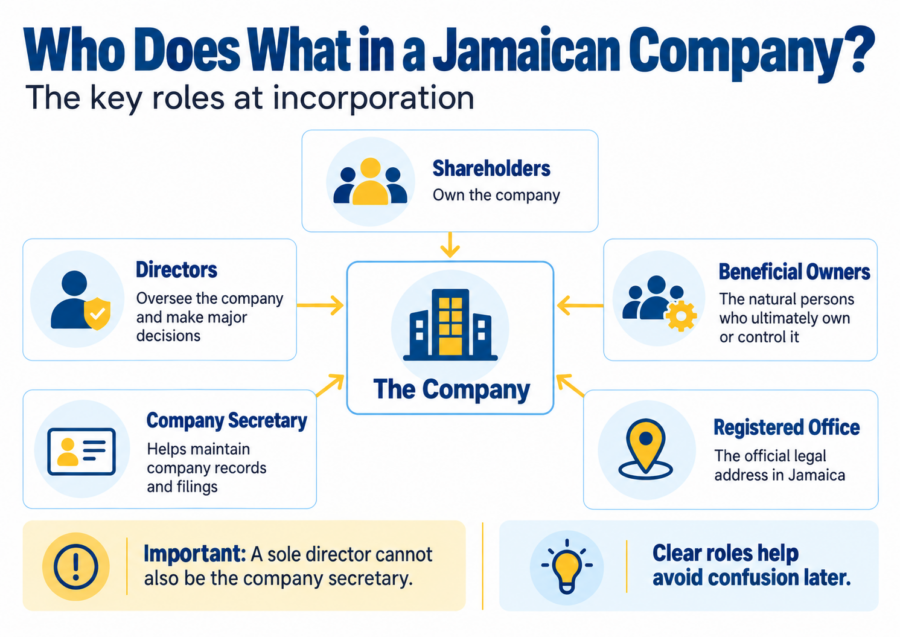
4. Identify the Company’s Beneficial Owners
Jamaica now places significant emphasis on beneficial-ownership reporting.
A beneficial owner is, broadly, the natural person who ultimately owns or controls the company or enjoys the benefits of that ownership.
COJ requires companies to identify their shareholders, members and beneficial owners and provide the required identification information. Beneficial Ownership Return Forms A and/or B form part of the incorporation requirements.
This means using another company or nominee as the immediate shareholder does not necessarily remove the requirement to identify the person who ultimately owns or controls the interest.
Beneficial-ownership reporting is not merely an incorporation issue either. Changes may trigger further filing obligations with COJ.
For that reason, ownership should be properly documented from day one.
5. Choose Your Director or Directors
Every private company must have at least one director.
However, there is an important practical point for someone planning to create a one-person company:
a sole director cannot also serve as that company’s company secretary.
COJ’s current Form 1A expressly states that a private company must have at least one director and that the sole director cannot also be the company secretary.
Therefore, even where one person owns 100% of the company’s shares and serves as the only director, another eligible person will need to serve as company secretary.
Larger businesses should consider carefully who is appointed as a director.
A directorship is more than a title. Directors have responsibilities connected with the management and governance of the company, and significant company decisions should be properly documented.
6. Appoint a Company Secretary
The company’s first secretary must be identified as part of the incorporation information.
The secretary is an officer of the company and is commonly involved in maintaining corporate records, resolutions, registers and statutory filings.
For a very small company, the secretary may be an individual other than the sole director. Larger organisations may use a suitably experienced internal officer or an external corporate-secretarial provider.
Details concerning the company’s first secretary are captured during the incorporation process, and subsequent changes to the secretary must be reported to COJ.
7. Decide on the Company’s Registered Office
Every Jamaican company needs a registered office situated in Jamaica.
This is an important legal address rather than merely somewhere to receive occasional mail.
Official communications may be sent to the registered office, and COJ treats this as the company’s formal address on the register.
The address therefore needs to remain current.
If the registered office changes after incorporation, COJ must be notified. Current COJ guidance provides for notification within 14 days of a change.
Do not continue using an old registered-office address simply because nobody remembered to update the company’s records.
8. Gather the Information and Identification You Will Need
Before starting the application, gather the information for the shareholders, beneficial owners, directors, secretary and person completing or declaring the application.
Depending on the circumstances, this may include government-issued identification, TRNs, residential addresses and other identifying information.
Professional certification may also be necessary where the company will operate in certain regulated professions or use particular professional descriptions.
Foreign applicants should also determine whether immigration or work-permit requirements apply to the individuals who will actually work in Jamaica. Incorporating or owning a Jamaican company does not, by itself, eliminate immigration and work-permit requirements.
COJ’s current guidance also requires identification of shareholders and beneficial owners and indicates that at least one responsible company officer must have a Taxpayer Registration Number.
9. Prepare the Articles of Incorporation
The Articles of Incorporation establish important elements of the company’s legal structure.
For a normal profit-making company limited by shares, this is generally Form 1A.
The Articles deal with matters such as the company’s name, registered office, share structure, restrictions on transfers, number of directors and any restrictions placed on the business the company is permitted to conduct.
This is not a form that should necessarily be completed casually.
For a simple owner-managed business, standard provisions may be suitable.
For a business with several shareholders, investors or succession arrangements, consider whether additional provisions are needed.
A company involving three unrelated shareholders, for example, may require considerably more planning than a company owned entirely by one person.
The Articles also should not be confused with a shareholders’ agreement. In businesses with multiple owners, a separate shareholders’ agreement may be useful to address issues such as voting, deadlock, restrictions on transfers, exits, death of a shareholder and dispute resolution.
10. Complete the Business Registration Form – the BRF1
The Business Registration Form, commonly called the BRF1 or Super Form, is a central part of the incorporation process.
It captures information concerning the company, directors, company secretary and registered office while also facilitating information required for other statutory agencies.
The integrated registration system is designed to connect the new company with agencies including Tax Administration Jamaica, the National Insurance Scheme, the National Housing Trust and HEART/NSTA Trust.
This is one of the reasons starting a company in Jamaica is no longer necessarily a matter of visiting several agencies separately just to establish the entity.
However, do not interpret the integrated system to mean that every future tax or employer obligation is automatically taken care of.
Registration is only the beginning.
11. Complete the Beneficial Ownership Return
The incorporation package must also include the applicable Beneficial Ownership Return – Form A and/or Form B.
COJ states that companies are required to identify and provide information concerning shareholders, members and beneficial owners.
Ensure that the information is consistent across the incorporation documents.
Names, addresses, ownership interests and other particulars should not contradict each other from one form to another.
Incomplete or inconsistent filings are an avoidable reason for delays.
12. Submit the Incorporation Application to the Companies Office of Jamaica
Once the Articles, BRF1, beneficial-ownership information and supporting documentation are ready, the incorporation package can be submitted to the Companies Office of Jamaica.
COJ has progressively digitised its services, so anyone following an old guide that tells them to complete every transaction in person should check the current process first.
In 2026, COJ transitioned several ongoing company compliance services to mandatory online filing, including certain annual-return, beneficial-ownership, registered-office, secretary and director filings.
Use COJ’s current website and instructions rather than relying solely on a checklist prepared several years ago.
How much does it cost to register a company in Jamaica?
Government fees change periodically.
At the time this guide was reviewed, COJ’s online fee schedule listed a standard package involving the Articles of Incorporation, BRF, stamp duty and beneficial-ownership return at J$27,500.
Treat that figure as a reference point rather than a permanent price.
Professional fees for an accountant, attorney, company-formation provider or corporate-secretarial service would be separate from COJ’s government charges.
How long does company registration take in Jamaica?
COJ guidance indicates that an application that is complete and in order may result in a Certificate of Incorporation within approximately four working days. Expedited services may also be available for an additional fee.
Processing times should not be treated as guarantees.
Errors, unusual company names, regulated activities or incomplete beneficial-ownership information can affect the process.
What Happens After Your Company Is Incorporated?
Receiving the Certificate of Incorporation is a major milestone, but it is not the end of the process.
In some respects, this is where running the company actually begins.
13. Confirm Your Company’s TRN and Statutory Registrations
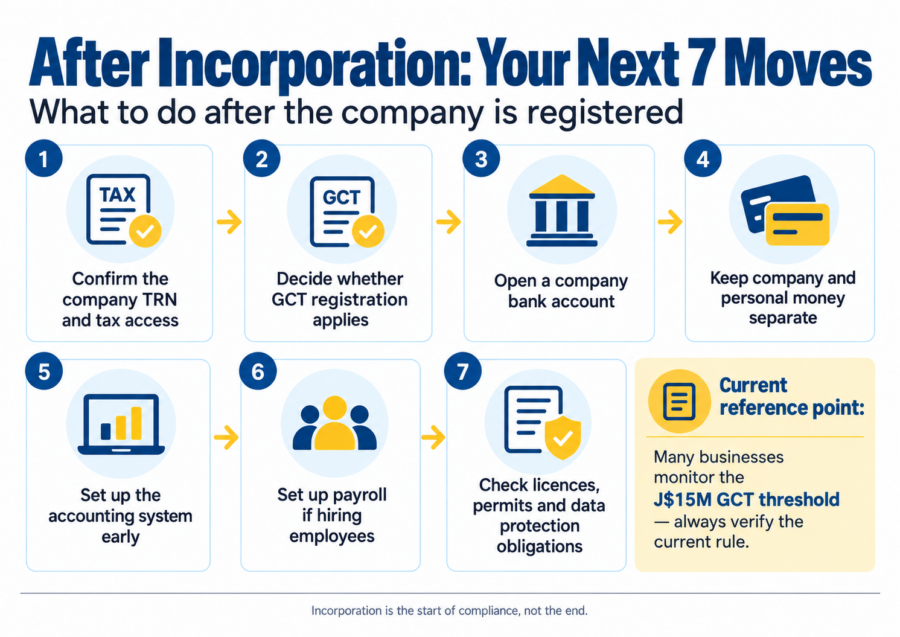
The BRF process is intended to facilitate registration information for the company’s TRN and relevant statutory agencies.
NHT explains that information from businesses registered through COJ can be routed electronically to the relevant agencies for creation of statutory records.
Keep a permanent digital record of the company’s:
Certificate of Incorporation, Articles of Incorporation, company TRN, company number, NIS employer reference where applicable, NHT and HEART information, beneficial-ownership filings and subsequent statutory documents.
Do not depend on someone’s inbox to serve as the company’s permanent records system.
14. Create and Activate the Company’s TAJ Online Access
A Jamaican company will interact with Tax Administration Jamaica (TAJ) throughout its life.
The company’s tax portal is used for filing returns, making tax payments and dealing with various compliance matters.
Do not wait until a filing deadline to establish access.
Make sure the appropriate persons can access the company’s account and that responsibility for filings is clearly assigned.
This becomes especially important if an outside accountant handles the company’s tax filings while an owner or finance employee handles payments internally.
15. Determine Whether the Company Needs to Register for GCT
Do not assume every newly incorporated company should automatically add GCT to its invoices.
Whether a company is required to be registered to collect General Consumption Tax depends on its activities and the applicable registration rules and threshold.
The Government increased Jamaica’s GCT registration threshold for relevant MSMEs from J$10 million to J$15 million, effective April 2025.
Because thresholds can change through future Budgets and legislative amendments, always verify the current threshold before relying on this figure.
There is also an important difference between being registered with the tax authorities and being authorised to charge customers GCT.
A business should not simply add GCT to invoices because it has incorporated.
Businesses approaching the registration threshold should monitor revenue rather than waiting until year-end to discover that the threshold was crossed months earlier.
16. Open a Company Bank Account
Once incorporated, establish a bank account in the company’s name.
Banks have their own Know Your Customer and anti-money-laundering requirements, so the exact documents can vary.
Expect to provide corporate documentation such as the Certificate of Incorporation, Articles, TRN, information on directors and beneficial owners, identification and proof of address. Depending on the institution and account, board resolutions, business information and evidence relating to the source of funds may also be requested.
Check directly with the bank before preparing your package.
Most importantly, once the account is operating:
keep company money separate from personal money.
Repeatedly paying private expenses from the company account or collecting company revenue into personal accounts makes bookkeeping, tax reporting, cash-flow management and financial analysis unnecessarily difficult.
Incorporating a business but continuing to handle its money as though it were a personal side hustle defeats a major part of the benefit of formalisation.
17. Set Up the Accounting System Before Transactions Begin
This is one of the most overlooked steps in starting a company in Jamaica.
The best time to establish your accounting system is not six months after you start trading.
It is before the first invoice is issued.
Your accounting setup should be capable of recording sales, customer receivables, expenses, supplier payables, bank transactions, assets, loans, shareholder transactions, taxes and payroll where applicable.
You should also decide how invoices will be generated, who can approve payments, how receipts and supporting documents will be stored, how bank reconciliations will be performed and how frequently management accounts will be prepared.
A business doing J$5 million in annual sales may be able to correct poor record-keeping relatively easily.
A business doing J$250 million with weak accounting processes has a much larger problem.
The accounting system should therefore be designed for the business you intend to build, not merely the transactions you have during your first month.
18. If You Hire Employees, Set Up Payroll Correctly
Hiring employees introduces another layer of compliance.
Employers may have obligations covering PAYE, NIS, NHT, Education Tax and HEART contributions.
Monthly statutory deductions are generally reported through the SO1, with amounts normally due by the 14th of the following month.
The employer annual return, SO2, also has its own filing requirement. NHT currently states that the SO2 is filed online through TAJ by March 31 following the contribution period.
Contribution rates, ceilings, income-tax thresholds and other payroll rules can change.
Payroll calculations should therefore be updated whenever Jamaica’s statutory rates or tax thresholds change.
Do not rely permanently on a payroll spreadsheet created several years ago.
19. Check Whether Your Industry Requires a Licence or Additional Approval
A Certificate of Incorporation does not automatically give a company permission to conduct every type of business.
Additional approvals may apply depending on the industry.
Jamaica’s Business Gateway currently provides pathways for approvals or information relating to areas such as hospitality, tourism attractions, cannabis, farms, factories, telecommunications, quarrying, mining, healthcare facilities, pharmaceuticals, food-processing establishments, construction-related approvals and other regulated activities.
Professional activities may also require licences or certification.
Before signing a lease, purchasing expensive equipment or advertising a regulated service, establish which approvals are necessary.
20. Consider Your Data Protection Obligations
Modern businesses collect a significant amount of personal information.
Customer names, telephone numbers, email addresses, employee records, payroll information, identification documents, CCTV footage and online customer information may all involve personal data.
Jamaica’s Data Protection Act therefore needs to be part of the compliance conversation.
The Office of the Information Commissioner states that data controllers processing personal data are required to register with the OIC.
Businesses should determine whether they are acting as data controllers, establish appropriate privacy and security procedures and check the current OIC registration process.
Because administrative procedures, registration windows and fees can change, refer directly to the OIC for the latest process rather than relying on an old checklist.
Your Company Is Registered. What Must You Continue Filing?
Incorporation creates ongoing obligations.
A company does not remain compliant simply because it once received a Certificate of Incorporation.
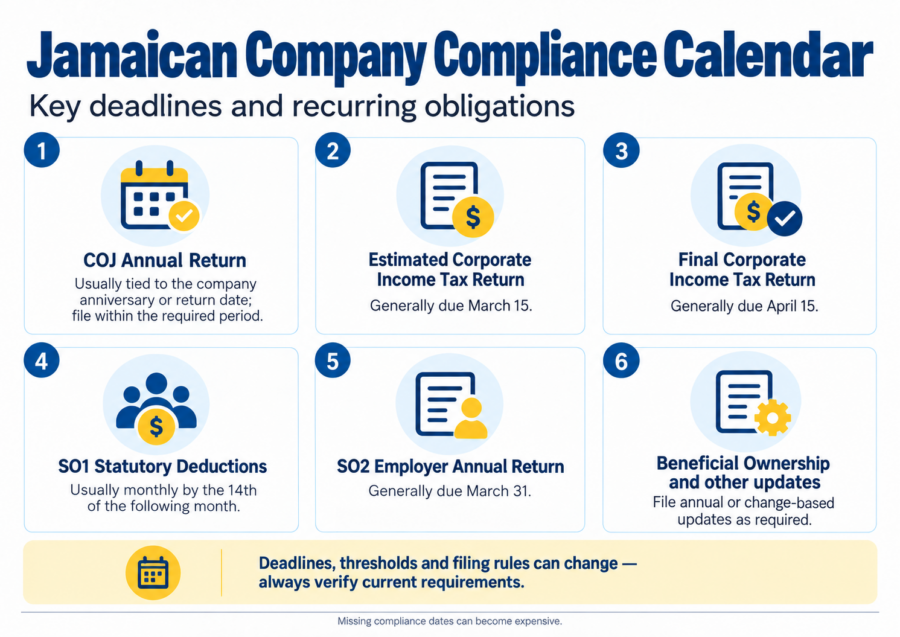
Here are some of the key recurring deadlines to place on your compliance calendar:
| Obligation | General timing to monitor |
|---|---|
| COJ Annual Return | Based on the company’s anniversary/return date, with a 28-day filing period |
| Beneficial ownership information | Annual reporting and filings when relevant changes occur |
| Corporate estimated income tax return | Generally March 15 |
| Final Corporate Income Tax Return | Generally April 15 for affected corporate entities from the 2025 year of assessment onward |
| Estimated corporate tax payments | Generally quarterly |
| Employer SO1 | Generally by the 14th of the following month |
| Employer SO2 | Generally by March 31 |
| GCT filings | According to the company’s applicable GCT filing obligations |
| Industry licences | According to the regulator’s renewal requirements |
| Data-controller registration | In accordance with OIC requirements |
COJ states that annual returns must generally be made up to the relevant company return date and filed within 28 days. Companies remain subject to Companies Act obligations while they remain on the register, even where they are not actively carrying on business.
One particularly important tax change occurred in 2026. Jamaica moved the final Corporate Income Tax filing and payment deadline from March 15 to April 15, beginning with the 2025 year of assessment. The estimated corporate income tax return continues to have a March deadline.
This is a good illustration of why a business should maintain a compliance calendar that is reviewed every year instead of relying indefinitely on last year’s deadlines.
What If the Company Has Not Started Trading Yet?
This causes confusion for many new company owners.
You register the company in June.
Plans change.
December arrives and the business has still earned no revenue.
Does that mean nothing needs to be filed?
Not necessarily.
TAJ has specifically reminded companies that an income tax return may still be required even where the company has not begun trading or has made a loss.
COJ obligations can also continue while the company remains on the register whether or not it is actively conducting business.
“Inactive” should therefore never automatically be interpreted as “no compliance required.”
If a company was incorporated for a project that never got off the ground, get professional advice on the filings that remain outstanding and, where appropriate, the formal process for closing or removing the company.
Common Mistakes When Starting a Company in Jamaica
The registration form itself is rarely the most expensive part of getting a company wrong.
More costly problems usually emerge afterward.
Common examples include choosing shareholders without properly agreeing on ownership, using personal bank accounts for company transactions, failing to document money introduced by shareholders, charging GCT incorrectly, missing payroll deductions, ignoring annual COJ returns, waiting until tax season to reconstruct the accounts, forgetting to update beneficial-ownership information and assuming that incorporation replaces industry-specific licences.
Another common mistake is registering a company before understanding how the operation will make money.
A Certificate of Incorporation creates a legal entity.
It does not create a viable business model.
Before taking on rent, employees, vehicles, equipment or debt, management should understand the company’s expected revenue, gross margins, recurring costs, working-capital requirements, break-even point and cash needs.
How Much Money Do You Need to Start a Company in Jamaica?
There is no single answer.
The government cost of incorporation is only one part of startup expenditure.
A consulting company working remotely may need relatively little capital.
A restaurant, construction operation, distributor, manufacturer or tourism business may require significant upfront expenditure on inventory, equipment, premises, licences, deposits, insurance and employees before the first dollar of revenue is collected.
Prepare a startup budget before launching.
Separate one-time startup costs from monthly operating costs and calculate how many months the company can operate before it must become cash-flow positive.
This is particularly important for businesses that sell on credit.
A company can be profitable on paper and still run out of cash while waiting 60 or 90 days for customers to pay.
Do You Need an Accountant to Register a Company in Jamaica?
Not necessarily.
A straightforward company can be incorporated without appointing an accountant to complete the registration.
But registration and accounting are two different issues.
An accountant can become particularly useful when you need to determine the company’s tax obligations, configure the accounting system, structure payroll, establish financial controls, prepare management accounts, evaluate GCT registration, prepare annual financial statements or file tax returns.
The larger or more complex the operation, the more expensive it becomes to correct accounting problems after the fact.
Do You Need a Lawyer to Start a Company in Jamaica?
Again, not necessarily for a simple incorporation.
Legal advice becomes more valuable where there are multiple shareholders, outside investors, unusual share rights, intellectual property arrangements, significant contracts, complex ownership, foreign investors, regulated activities or a need for a shareholders’ agreement.
The registration process may be relatively straightforward.
The relationships behind the registration sometimes are not.
Can One Person Own a Company in Jamaica?
A private company can be structured with one owner and one director.
Remember, however, that COJ’s current Form 1A states that where there is only one director, that director cannot also be the company secretary.
Ownership, directorship and the office of company secretary are separate concepts.
Can a Foreigner Start a Company in Jamaica?
Jamaica generally maintains an open investment regime and its National Investment Policy provides for treatment of local and foreign investors subject to applicable Jamaican law and sector-specific restrictions.
Foreign ownership should not, however, be confused with permission for an individual to work or reside in Jamaica.
Depending on the circumstances, work permits, immigration requirements and sector-specific approvals may still apply.
Foreign investors should also obtain tax advice concerning residence, withholding taxes, repatriation of profits and any applicable double-taxation treaty.
How Much Is GCT Registration in Jamaica?
The more important question is usually whether you are required to charge GCT.
The current general registration threshold relevant to many businesses is J$15 million in annual taxable supplies, following the increase announced for 2025.
However, GCT rules contain exemptions, different treatments and industry-specific considerations.
Do not determine your GCT position using the revenue threshold alone.
And because government thresholds change, verify the current figure with TAJ before making a registration decision.
What Is the Difference Between the COJ Annual Return and a Tax Return?
They are different filings submitted to different authorities for different purposes.
The COJ Annual Return deals primarily with the company’s corporate information and is filed with the Companies Office of Jamaica.
The Corporate Income Tax Return reports financial and tax information to Tax Administration Jamaica.
Filing one does not automatically satisfy the other.
Businesses sometimes fall behind because someone says, “The annual return was filed,” without clarifying which annual return they mean.
A proper compliance calendar should distinguish between them.
A Practical Checklist Before You Start Trading
By the time the company begins operating, management should be able to answer yes to the following questions:
Is the company properly incorporated? Is its ownership clearly documented? Are the directors, secretary and registered office correct at COJ? Is beneficial-ownership information accurate? Are the company’s TRN and statutory registrations confirmed? Is the company bank account operating? Has the GCT position been determined? Is an accounting system in place? Is there a process for issuing invoices and retaining receipts? Have payroll obligations been established if employees are being hired? Have necessary licences and permits been identified? Have data-protection obligations been considered? Does someone know every important filing deadline?
If several of those answers are “no”, the business may technically exist but may not yet be operationally ready.
Starting a Company Is the Easy Part. Keeping It Compliant Is the Real Work.
Starting a company in Jamaica has become considerably more streamlined.
You can establish the legal entity, receive a company number and connect the business with several government registration systems without navigating the number of separate processes that existed years ago.
But incorporation should be viewed as the beginning of the business’s compliance journey, not the end of it.
As the company grows, its accounting records, taxes, payroll, licences, data-protection responsibilities, beneficial-ownership information and Companies Office filings all need to grow with it.
The businesses that tend to encounter problems are not always those that deliberately ignore the rules.
Often, they are companies that started informally, grew quickly and never upgraded the systems behind the growth.
Getting the structure right from the beginning is usually easier, and less expensive, than trying to reconstruct years of records later.
Need Help Setting Up the Financial Side of Your New Company?
Charles O’Connor Consulting Network Ltd. works with Jamaican businesses on accounting, payroll, tax and advisory services.
If you are starting a company or formalising an existing operation, we can help you put the accounting and compliance processes in place so that your financial records are built properly from the start.
Call: 876-908-0486-7
Email: clientservices@cocnjamaica.com
Visit: cocnjamaica.com
This article provides general information and should not be treated as legal, tax or regulatory advice for a specific business. Requirements, government fees, thresholds, forms and procedures may change. Always confirm current requirements with the Companies Office of Jamaica, Tax Administration Jamaica and any other regulator relevant to your business before acting.